By Germain Chamot
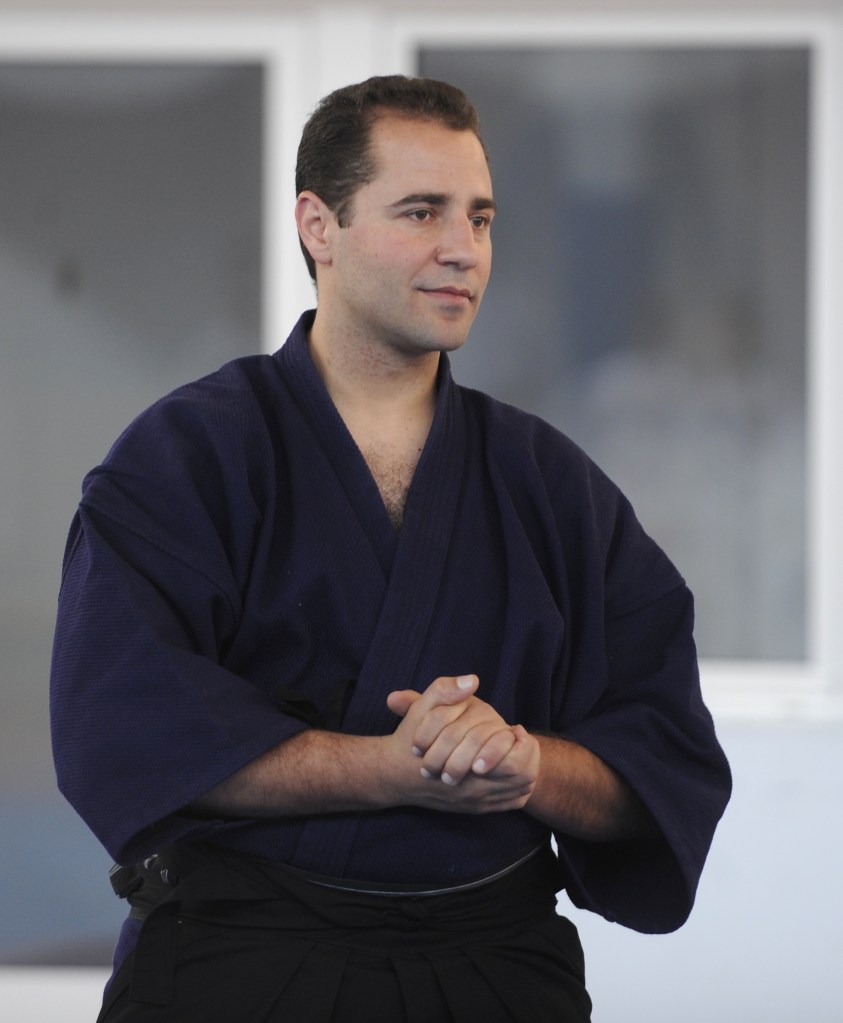
Marco Pinto is a first hand instructor of the famous Takamura-Ha Shindō Yōshin-ryū, a pre Meiji era traditional school held by Tobin Threadgill sensei. He also has been extensively training in Wadō-ryū karate-dō. He is sharing his cross experience of gendai budō and koryū.
Why did you start martial arts?
With my brother Artur, since we were kids we have always been fighting. The whole idea that surrounds martial arts has always been very appealing for us. Fighting and playing with swords is a part of the childhood of most children and we were not different. The fact that our father had done jūdō with one of the legends of Portuguese jūdō, a Kōdōkan 9th dan: Kobayashi Kiyoshi, also played a part in drawing us into formal training, making us interested in pursuing this in a more serious manner.
But you ended up doing karate?
Yes. Living in a small town, there was not much martial arts practice available. Eventually that led us to the local karate club under the tutelage of Mr Luís Tomé. The fact that – by chance – Wadō-ryū was the karate school being taught had a decisive influence over our lives for the following 35 years. I started at 11. We kept on practicing karate seriously for several years and got heavily involved in international competitions. Eventually this led us to study the deeper side of Wadō-ryū. (Ryū: school)
Which led you to discover Takamura-Ha Shindō Yōshin-ryū (TSYR)?
In the early 2000s, there was this idea that Shindō Yōshin-ryū (the school of the new way of willow tree) had disappeared, and that Ōtsuka sensei, the founder of Wadō-ryū, was the last person to have received a menkyo kaiden (higher level of teaching licence). We thought everything had been dwelled into Wadō-ryū and Shindō Yōshin-ryū, as a stand alone art, didn’t exist anymore. So when Takamura sensei gave his interview for the aikidō Journal, that sort of revolutionized the Wadō-ryū world quite a lot .
When I eventually was informed that Threadgill sensei was teaching seminars in Palma de Maiorca, Spain, I attended one of them on the first chance I had and maybe two or three years later after that first meeting with Threadgill sensei, my brother and I started a study group in Portugal. Within a year Threadgill sensei issued both of us shōden teaching licenses and that was the beginning of our journey.
Why did you involve yourself in TSYR?
To be honest, at that time I was doing Shindō Yōshin-ryū with an interest in the historical connection but through a perspective of finding how this aspect could be employed to develop my Wadō karate practice. As time went by, for both my brother and I, TSYR became the main focus of our martial arts practice and we ended up establishing a very close relationship with Threadgill sensei.
Can you tell us more about TSYR?
Shindō Yōshin-ryū is mainly influenced by two different lines of Yōshin-ryū: Yōshin koryū and Akayama Yōshin-ryū. There are also strong influences from Shinkage-ryū and Jikishinkage-ryū.
Takamura sensei once said that Shindō Yōshin-ryū was not a koryū (an old traditional martial school). This statement has been largely misunderstood: actually, in his mindset the definition of koryū was a Sengoku-jidai era school (period of civil wars between 1477 and 1573), and TSYR is not from that time frame but is from the late Edo period (period of relative peace between 1600 and 1868). Although the core of the school is defined by the era of its formation, we also still preserve some kata in our curriculum which are clearly battlefield oriented. They are very rough, energetic and frontal. But it is only around 25 kata of the entire curriculum.

What about Yōshin koryū?
It is a more passive form of jūjutsu which was employed mainly for bodyguards. It means you are not actively seeking confrontation. The whole willow tree mythology corresponds to that, while the Akayama Yōshin-ryū is a much more offensive school. For instance, the principle of tō no mae, the sword forward, comes both from Shinkage-ryū and Akayama Yōshin-ryū. The sword always seeks the opponent. But in Yōshin koryū you are more blending and changing angles.
You talk a lot about the sword…
We don’t call ourselves a kenjutsu school (techniques of the katana). Although the sword is very present, we are a jūjutsu school. We don’t separate each art. We are considered as a sōgō jutsu, a comprehensive martial arts school. Everything we do is Shindō Yōshin-ryū.
How many kata do you have in the School?
The official number is 305! On top of those, there are a few sections of the jōden curriculum that we don’t count as kata… for example, something that we call the fukuru no gyo, although gyo is just an alternative name for kata.
Can you explain that further?
The kanji used for kata in Okinawan schools is « form », as in a mold. Everything that is poured into the mold takes the form: same proportion, same size; whereas, in TSYR the kanji for kata is gyo. It has the connotation of something that gets shaped into something else. It evolves, it is more personalized and adaptable.
The kata itself is not something that is equal. There is a baseline of principles but things are adaptable and personalized. Simply because everybody has different bodies, different strengths and weaknesses, so the kata may be adapted to that.
Wadō-ryū, probably through the Shindō Yōshin-ryū influence, also uses the kanji gyo for their kata, unlike other okinawan karate schools.
It seems quite a modern idea, or was it like this in the past?
I cannot say for sure obviously, but Hokushin Itto-ryū influenced Shindō Yōshin-ryū pedagogy and teaching methods. This particular school got some influences from the methodology and pedagogy that was being used to teach western medicine in Japan in the 1800s by German doctors. The idea was to develop methods to create better warriors in a shorter time frame. So the principles are always the same, whether you are empty handed or using a sword, a knife or a staff.
Does this kind of pedagogy generate more autonomy?
If you understand the logic behind the principle of motion, you can figure out what you are doing wrong. It is not a matter of left foot here or right foot there. It is a matter of you examining how well you are achieving kuzushi (imbalance) or how connection is established. That becomes adaptable to every partner. Threadgill sensei describes this as a toolbox: the more principles you get taught, the more tools you have. The richer your toolbox is, the easiest it is for you to fix a particular problem.
If you have a big toolbox, how would you pick the right tool at the right moment?
That’s when experience comes into play and also the reason why teaching has different phases. If the student is overwhelmed with new “tools” he will struggle to figure out which one is the right one to use at a given point.
Are there ways to tide up the toolbox?
This is why we segment our teachings into 4 levels : shōden, chūden and jōden which is divided into two parts.
In each scroll (the school’s “catalog”), there is a section of reihō and there is a section of ura waza (“hidden” techniques) where principles of movement and mental principles are described. This stratifies the teaching so you don’t get overwhelmed with tools. Progressively you learn more and more principles and eventually your ability to choose what to employ and when to employ it, builds up as well.
What are reihō?
Reihō are the etiquette methods that you’ll find in all the interactions within a dōjō. These are not only bowing in the beginning of kata, these permeate the entire art, and influence certain aspects of kata in the sense that different etiquettes were used in different time frames, and it provides some context to some actions. Being koryū, the reihō is significant as it also impacts the social interactions amongst students and relationships with people from other arts.
What distinction do you make between omote and ura kata?
Omote kata is the orthodox form of the kata that we use to convey the principles of the art. Omote assumes that both shitachi and uchitachi are of similar sizes and level of skill. It is our primary method to teach the art and what we actually spend more time focusing on.
Ura kata is the second layer of the onion. It is when the core principles of the kata are explored and observed under different lights, which assumes that the student already has some depth of knowledge of the art and the actual kata.
Given that we are on the subject, our definition of kata also comprises another aspect: henka. These are our personal variations of the kata, when the form becomes “ours” and the kata is expressed in a unique way by ourselves, that possibly could be slightly different from another person’s, without losing adherence to the core principles of the kata.
It’s an idea built up on the Shu-Ha-Ri model, that makes kata alive and interesting, something that could be lost if we focused on omote kata only.
In that regard, how is the progression within the school?
My personal experience has been the following: at shōden – basic level – everything was fairly easy. In the sense that it is very black and white, right and wrong. The further you evolve, everything becomes messy and grey: « Is it right? Maybe yes, maybe no, maybe you can go here, maybe you can go there ».
There are things that are completely wrong, obviously, but in the realm of « OK » lots of things can fit. They are not absolutely perfect, but they are not entirely wrong either. That is the time when it’s very easy to get confused.
Then what is actually the function of kata?
For me, only when one can look at the entire curriculum, is when things do make sense. And I think this is true for most koryū. When I got to start training at jōden level, the entire curriculum gained a new dynamic as to: « now I understand why we are doing this at this level, with this particular aim ».
Each kata is actually trying to teach a specific lesson. And the lessons are usually not repeated. If you had two kata to teach the same thing, one of the two would be taken out, because it would be just extra stuff for no good reason.
It is our job, as students, to learn those kata, learn the principles and extrapolate all of that into other scenarios, circumstances. So in our curriculum at the intermediate level, I think it is probably the hardest place to be as a student because we get very confused. And obviously when we see sensei, it is always wrong (!). But you do have a sense that some things are working quite well without nothing being definitive.
Takamura-Ha Shindō Yōshin-ryū seems to have a specific pedagogy…
Most schools, most lineages, lost track of a good consistent training pedagogy and how to teach theory. Because they started to overemphasize the applications, like in combat sports. This is not good or bad, it is just the way things evolve. Things become more oriented only towards results, at any cost, instead of following a process, a pedagogy and a methodology, to lead you to a certain spot. While in many koryū we have the exact opposite, with training through focusing on forms, only and never evolving past that point.
I believe that somewhere in the middle of those spots, is where we should be. This is pretty much what we try to do in TSYR when we practice freestyle combat and use shinai geiko (training with split-bamboo swords).
But it is done at upper chuden level, when people are fairly experienced, and already have a pretty good understanding of the technical basis of the school. We don’t get six months students whacking each other. It can be fun, but will that produce a positive result on the evolution of the student? Probably not.
So the student has to go through a specific process?
The teaching of the school is supposed to transform you in such a way that the technique does not really matter anymore. Then you become the expression of the school. It is great on a personal level, but as a teaching model, it is terrible. And in my opinion, that is what often happened in some aikidō lines: some teachers achieved a certain level and they were great, but the process on how to get there got lost, especially because some of these teachers were geniuses.
Threadgill sensei says sometimes that one of the worst things that can happen to a school is to have two geniuses in a row. When there is one genius, he will have people around that understand the pedagogy and the methodology to bring people to that level, so when he is gone, they will help others to develop, even if they are not geniuses themselves. But when you have a succession of two geniuses, there are two generations of people that are just absolutely mind blowing, but by the third generation no one understands a word they are saying and no one can replicate anything they are doing. It is at the same time fantastic and sad for the school.

You explained that the sword comes first, then the body follows…
The idea of tō no mae is that the kissaki (the tip of the katana) always goes first and then the body closes the gap. If it is not a sword, it is the hand or whatever you are using, that starts moving towards your opponent. There is never the idea of a complete positioning first. At a basic level we kind of reinforce this to prevent people from being exposed to a counter while getting into the distance of the opponent. At a certain level of ability the two motions are almost done together.
Do you think this is something common to all the koryū or is it specific?
I wouldn’t be able to say. I have had experiences in other lineages and some schools have very different approaches. There are schools that have an approach of step cut, and others that have the idea of the sword first and then the body follows.
Can you explain the different types of cut you use?
There are various cuts, but all of them are performed in either oshi giri or hiki giri. In oshi giri, the sword is pressing forward, in hiki giri, the cut is pulling backward, although the pullback is never performed with our hands or arms. There is also never the idea of chopping. The fact that we are always pulling with our feet, although at times in a very minimalistic way, always ensures that the sword is still moving in or out, while it is cutting. That allows you to take the best possible advantage of the curvature of the sword. If you just hit straight on, the fact that the sword is curved or straight would be almost irrelevant.
What about the body drop?
We are almost always pulling with the legs and employing the body drop, tai otoshi. We don’t press ourselves from the floor, neither would we use any preparatory action. When you just pull your feet from underneath you, that allows gravity to pull you down in a very efficient fashion. Most of the time when we hit or cut, we use tai otoshi.
In tai otoshi, everything is involved at the same time, arms, body, legs. But it does not mean being a wooden staff, it means that everything is synchronized and done at the same time.
How do you rotate?
We usually use three axes. The central axis and two axis located over the head of the two femurs. Depending on the context, you might use your upper body rotation differently.
You talked about the ability to change…
The idea of the ability to change your body, your technique and your mind at the same time comes from the conjugation of several principles such as kobo ichi, jū no ri and chūshin tadasu, for example, or suishin no suitai and mukei. You can change each of these things individually, or you can change them all at the same time. We should have, at any given moment, the ability to change everything. You must never be completely committed to where you are going to end, so you are able to adapt, correct or even retreat at any given time. In Wadō-ryū these ideas were also adopted under the principle of san mi ittai.
How do you deal with grabs?
Grabs are attempts to restrain someone, either to hit them or to prevent them from drawing their weapons. The assumption is that there are always weapons involved. If I perceive you as a threat, one of my first attempts would be to restrain your hands to prevent you from drawing your weapon, maybe I will also strike you while doing so to gain the upper hand. So that is the context in which we use hand wraps. How much do we grab? A lot, but grabbing is always a means towards something.
Then is grabbing offensive or defensive?
That depends on the perspective… We try to differentiate between physical initiative and mental initiative. There are contexts where one might say that you are defending because you were grabbed and so you are defending yourself. If you are looking purely at the physical side, it is the case. But the mental initiative is that I already had the intention to draw my weapon. So you respond to that by grabbing my wrist. That happens a lot in our idori kata.
That being said, something that we don’t really do is to grab someone while having a defensive body posture. It doesn’t make sense, if I’m grabbing you, I’m trying to restrain you and either hit you or throw you. To grab you while leaning backwards and not committing power to the grab makes no sense.
How about which side you perform the grabbing?
Although we can practice them on both sides for the sake of practice, each kata has a specific side that it should be performed on. Most of the time what drives that is the presence of weapons. There are certain movements that you will not be able to do because you will run into the swords.
How about the fact that around 90% of people are right handed and then would grab with the left hand to hit targets with the right hand?
It is true also. Maybe in the context of kata, all you see is the hand grab. The rest never appears because the other guy then reacts and does his side of the kata. It is one of the things that we also worry while teaching: the supposed context. The things that you never see, that never appear in kata sometimes give all the sense.
You seem to have quite a lot seated kata
We do have 25 idori kata with no weapons, plus 10 idori kata with weapons. All of them have slightly different contexts. For example, there is a serie where we don’t sit in seiza. We do it in a position called hiro no kamae. You are on your knees, but you are on the ball of your foot and one knee is up. You do so because the context is that you would be wearing light armor. The sune, shin guards, prevent you from sitting in regular Seiza. It is never something that would be happening indoors, it is battlefield stuff, but you are not wearing the kabuto (helmet) and you are probably not wearing any sort of kote (forearm protection) or anything like that. But you have your do (torso protection) on.
Those sets of kata have a completely different feeling from the regular idori kata that you practice in seiza or heiza. Those are a little bit more battlefield oriented and not so much small finesse of movement that we sometimes find in the other kata. I think this is the result of being a little bit of a “mut school” that went through several different influences that got married into the same thing.
In Wadō-ryū, there are some idori kata as well. Do they all come from TSYR? Why have they been changed?
Several partner kata in Wadō-ryū came from Shindō Yōshin-ryū, others did not, they came from the Okinawan karate schools, just like the enren gata, or they were Ōtsuka sensei’s creation.
The motivation for some of the changes that were done in Wadō-ryū kata, I believe, were mainly due to safety issues. In some cases we need to consider that Wadō-ryū, in its beginnings, was being taught mainly at university buildings that had hardwood floors, which probably led to some throws being changed to make them safer to practice within that context.
Other aspects might have been changed due to Ōtsuka sensei‘s purpose of developing Wadō-ryū as an art from the commoners, an art that could be accessible to anyone and everyone. Within that context some techniques or skills would just be irresponsible to teach to the general public. He hints at this in several texts he wrote and even on the decision of adopting the seiza position for general use within Wadō-ryū, which was the position used by commoners in feudal Japan, opposed to the heiza position that is used in TSYR, which was the position that the samurai class would use in the pre-Meiji eras.

Do you have some specific tanren?
We have a series of kata, called the happo shinden naygiri no gyo, “the 8 divinely inspired exercises of internal power training”. They are addressing how to move and how to create a certain type of muscle building and a certain type of body tissue connection appropriate for TSYR. These exercises are done solo, and although those are very interesting, I believe that they become more relevant when you are a slightly more advanced student.
Are there links between naygiri no gyo and qi gong?
I would rather say yes, but I’m not knowledgeable enough of Chinese martial arts to be able to say if its links are with qi gong, or with another art or aspects within Chinese martial arts.
The naygiri no gyo come through the Akiyama Yōshin-ryū, and it is likely that its founder, Akiyama Shirobei, learned them through connections to China. He lived and established the art in the Nagasaki area in the 1700’s, and Nagasaki was already by then one of the major commercial ports of Japan. The coming and going of ships and people between Nagasaki and mainland China were an occurrence of daily life.
Akiyama learned Chinese martial arts and medicine through those connections but I don’t know of any record that might state exactly which arts he studied or with whom.
Are there some other solitary training exercises?
Our main solo training is batto jutsu, sword drawing. At a beginner’s level, I would advise people to focus a lot more on batto jutsu than on naygiri no gyo, don’t get me wrong though, naygiri no gyo is a very important skill and a very interesting training. But I think that at the beginner to intermediate level, sword work is a lot more relevant. The control of the kissaki, figuring out how to maintain proper hasuji (align the direction of the cut with the sword) is at the beginning more valuable than actual naygiri no gyo.
Do you use naygiri no gyo to do push hands as well?
The whole idea of being pushed without allowing yourself to be unbalanced is great, but it has to be put in context: how do you use that within kata to actually achieve something. Because if you are just sitting there and, great, you don’t move, it is a little bit of a party trick. You can do a very fun thing, but then you lack the ability to actually transfer it to applicability. There are basic drills within TSYR to develop these skills, but all this is also embedded within kata, one just has to know where to look for it. To develop naygiri skills and then to be able to use them in freestyle combat is the goal.
Like the unbendable arm in aikidō?
Same idea. It becomes only good when you are able to put that skill within a particular kata, waza, or into shiai.
What importance do you give to the movements of the scapula?
We focus quite a lot on this ability of moving the shoulder blade back and forth in naygiri no gyo. We also get outside-inside, moving the head of the humerus in a circle.
We actually use that for some of our kaeshi waza (counter techniques). Because when the body is locked in a particular way, the head of each bone sits perfectly in its casing. So when you have the ability to slightly misalign that, you can create space to create counters. Naygiri no gyo focuses a lot on that sort of motion, but not exclusively. These exercises also focus on building proper balance and a strong pair of legs. The very first kata of the series is called tekyaku. That literally translates into iron legs. It is basically a squat, on your upper body there are a bunch of things going on with the shoulder blades and elbows. But on your lower body you are just doing a very slow squat, in proper body posture.
How did TSYR change the way you practice Wadō-ryū?
I practiced Wadō probably 17 years before TSYR, so after I had started TSYR I could see how much of the riai is common to both schools, even if manifesting itself in different ways.
What I found was that there were some « holes », let’s put it that way, in my knowledge of the overall theory of Wadō. There was considerable overlaps, but also some gaps and some discords between TSYR and Wadō-ryū, as there should be, given that they are two different schools. Wadō-ryū has been strongly influenced by Shindō Yōshin-ryū, but also by Okinawan karate schools and others such as Ogasawara-ryū.
When I started TSYR everything had a logical progression. Everything had an explanation. Everything was A+B=C. So it was different from my beginning in Wadō where that logical progression was a bit lacking, maybe because the information might have been a little bit diluted with thousands of people practicing it worldwide and so many instructors. It is sometimes hard to have access to good, knowledgeable instructors in any art, and Wadō is no exception.
I believe that there are obvious crossovers between Wadō and TSYR, and my training in Wadō-ryū helped me a lot in my beginning of TSYR. That being said, each art has its own identity. If you want to be good at Wadō-ryū, invest time in training Wadō-ryū. Doing TSYR can provide you with some context and insights about why some things in Wadō are so different from other karate schools, but ultimately training TSYR will make you learn TSYR, not Wadō-ryū.
It seems that Shinto holds an important part of TSYR
Threadgill sensei says that for him shintō is the way of conveying Japaneseness. It is not a matter of beliefs, but it is a matter of how you interact with certain elements in your environment. Also how you comply with certain rituals that are sometimes relevant for technique and give you a better idea of the Japanese mindset.
In TSYR we do have a bunch of things like norito recitation that are definitely part of the school. There is kigan, haishi and norito. Those are like three different categories of « prayers ».
Do you always start the class with a norito?
Yes. Licensed or not, people should open classes like this, it is part of the training. At a higher level we learn other norito. And there are several rituals surrounding the school. There are rituals for example, for cleaning the blood from the tatami, which involves salt and water. If the blood is on the walls, we paint over it, and if the blood is on the ceiling, we leave it there (!).
It is always funny to think: « why does someone have to create a rule for blood on the ceiling? How often did that happen? » So there are all these Shinto connected things that permeate the entire school. We don’t teach them as a separate thing. It is alongside kata and regular training.
Threadgill sensei usually says that you don’t have to believe in shintō, you don’t have to do anything as long as you can comply with the rituals. Shintō should not be competing with any other faith, but it is important within our training and completely integrated into Shindō Yōshin-ryū.

What would you say are the assets of a koryū?
The unbroken line of transmission. In the majority of cases that doesn’t really happen in gendai budō (modern martial art born after 1868). I don’t want to say that koryū is better, but we have a more holistic view of the martial arts. I am sure there are people in the aikidō world that have the same view or the same capacity of having an integrated complete system, but usually they don’t get it just from aikidō alone. They have to fill those gaps with certain stuff from other sources, which is not a bad thing. Modern martial arts have the freedom to do that sort of thing. In koryū we are bound to kata. And if things get lost, there is no way to get them back. There is nothing to fill in the gaps. But in gendai budō, there is a lot more freedom and space for you to search and get elements from here and there and eventually fill in the gaps in your own way. It is not a bad thing. It allows the arts to evolve and move overtime and adapt. Is it better? Is it worse? Who knows? It is different for sure.
But the koryū approach is different, the main point is to get knowledge transmitted from one generation to another, otherwise it dies out, like it has happened to so many koryū. Even worse are the ones that are still extant, but are a shadow of themselves. They have been formally passed down through generations, but they have lost the knowledge beyond the omote, becoming empty shells that only mimic what they once were.
In a way one could think you have everything: the principles and the applications. gendai budō practitioners are sometimes missing valuable pieces of information because of incomplete transmission.
I understand what you are saying and I understand how you can perceive this as a good thing, but there is a downside to it: we have to maintain a curriculum of 305 kata.
It is a lot of work and if that does not get maintained, the school starts falling apart. One of the difficulties that we feel is how we can invest enough time to maintain the kata and at the same time lead people through getting more free from the kata and develop live applications, freestyle training. The tendency has been that people got too stuck in the kata. They learn that pattern and everything that requires stepping out of that pattern is challenging. Again, it is not a problem if your aim is to just maintain the technical heritage of the school alive and pass it down to another generation.
But if you are thinking that we are using the school to produce fighters, people that know how to handle confrontations, then you need to examine things a little bit better because it just takes too long. And the fact that you need to maintain all of this makes it an enormous task to get to that spot. While in modern schools, aikidō, karate, or combat sports, within a fairly small time frame, people know how to throw punches, to kick and they gain a minimum ability to fight.
How come TSYR seems to have both kata and fighting spirit?
We have been fortunate enough to have several of our senior instructors with previous experience in martial arts. This pre-acquired knowledge is conveyed into the TSYR world. Because in the TSYR methodology there is a process to go through before being exposed to combat or violence. Although competition is not exactly violence, it is one of the closest things that we have. It takes time. Threadgill sensei says that people that know how to fight are sometimes easier to teach, even if they are rough around the edges and he has to spend years saying: « relax, relax, relax ». People without that prior knowledge can learn how to do the kata very properly, but it will take them longer to get past a certain level because there is an element of reality that might be lacking.
If you don’t have that fighting spirit when you enter a fight, but you think that just because you know some techniques you will have the upper hand, you will get in trouble because of that false sense of confidence.
How is it to have your brother Artur with you?
My brother is my lifelong training partner. For the last 30 years, we have been training together on each Saturday morning, at least.
Some people training at higher levels within their arts are not so lucky, they might not have a similar level partner that they can rely on for their own personal training. Either they have partners from a very different level or there are people with similar levels that live far away.
We started karate together. We have done competitions together, we have been in the national teams together and we have fought together. We fought against each other, often.
And it is very liberating to know that I can punch someone as hard as I want, hurt him, but we won’t be mad at each other. That allows us to take things to an extreme level that sometimes we are not comfortable to reach with other people.
Having my brother around always made things easy. As we studied the same art, but with different perceptions our collaboration has been fruitful. I think that it is probably one of the explanations for the fact that we got our shoden licenses roughly a year after we took keppan (blood oath). Usually people take three to five years to get such a license.
What links do you make between kenjutsu and taijutsu? How do they influence each other?
They are two sides of the same coin. As a jūjutsu school whose about 40% of its curriculum is kenjutsu, we explore the same principles and the same body mechanics, both in kenjutsu and/or taijutsu. They constantly inform each other. There are specific aspects to each one, but the driving principles that characterize Shindō Yōshin-ryū have to be visible in both.
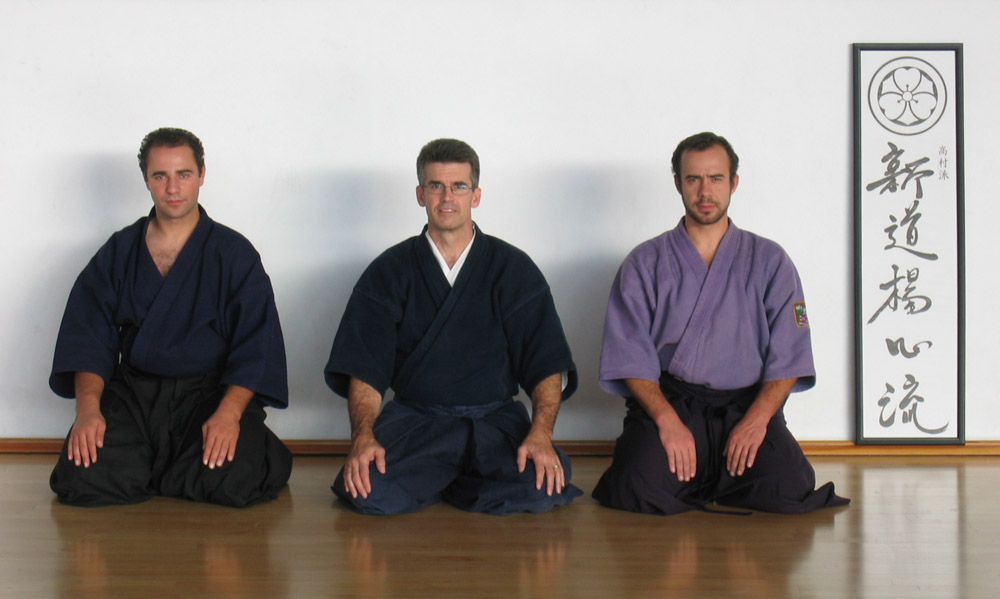
What would you say to someone who would like to join a koryū?
Do it! Many koryū are at risk of dying out, so new members provide the school with a chance of survival and avoid the loss of knowledge contained within that particular art.
That being said, training koryū won’t be suited to everyone, the structure and knowledge dates back at least 150 years and that will feel either stupid, irrelevant or out of place for many people. What one will value as some kind of lost treasure, will feel completely awkward to others. Lots of what is done in koryū are anachronic and have no place within modern society, which going back to your previous question, is probably one of the things that Wadō-ryū tried to avoid in its inception.
But even with all these difficulties, joining a koryū, TSYR in my case, has been a great experience. It has been a challenging journey, filled with obstacles, but the road is paved also with very rewarding experiences and shared with awesome people.
What are your plans for the future?
Keep on training and be at the service of my school.
My dōjō in Santarém, Portugal – the Shobukan – will continue to be a spot to train and teach Shindō Yōshin-ryū and I will most likely continue to teach some of the other European based dōjō as well as manage some of our study groups in Europe.
I will also continue to support the hombu dōjō in its activities and efforts to preserve Shindō Yōshin-ryū, as that has become the main purpose of my martial arts life.
Thank you very much Marco Sensei
 Aïkido Valence